- The Justice Walk Journey
- Posts
- Justice Walks October 2025
Justice Walks October 2025

Abby Anderson
October 21, 2025

Welcome to this month’s Justice Walk newsletter.
Thank you for opening this email and engaging in this conversation. I appreciate you.
This month newsletter highlights:
A reminder that our daily, “small” actions matter and multiply
A powerful recent conversation you can watch, read, or listen to
Let’s get to it!
Do you ever have that thing happen where you suddenly, obviously, and unavoidably receive the same message over and over again?
When these patterns emerge in my life, I know it means, “PAY ATTENTION!”
I don’t have to use lots of words to try to describe my most recent experience of this to you. I’ll simply share the evidence:
Exhibit A

A tweet from theleftistlawyer reads: “Folks, you can’t report the United States to its manager. There’s no superhero coming to save us. We don’t need one giant act of heroism. We need millions of small acts of solidarity. help one person in your community for nothing in return. Then, do it again. And again. That’s the revolution.”
Exhibit B
“Ours is not the task of fixing the entire world all at once, but of stretching out to mend the part of the world that is within our reach.
Any small, calm thing that one soul can do to help another soul, to assist some portion of this poor, suffering world, will help immensely.
It is not given to us to know which acts, by whom, will cause the critical mass to tip toward an enduring good.
What is needed for dramatic change is an accumulation of acts, adding, adding to, adding more, continuing.
We know that it does not take everyone on Earth to bring justice and peace, but only a small, determined group who will not give up during the first, second, or hundredth gale.”
Clarissa Pinkola Estes, A Letter to a Young Activist.
Exhibit C
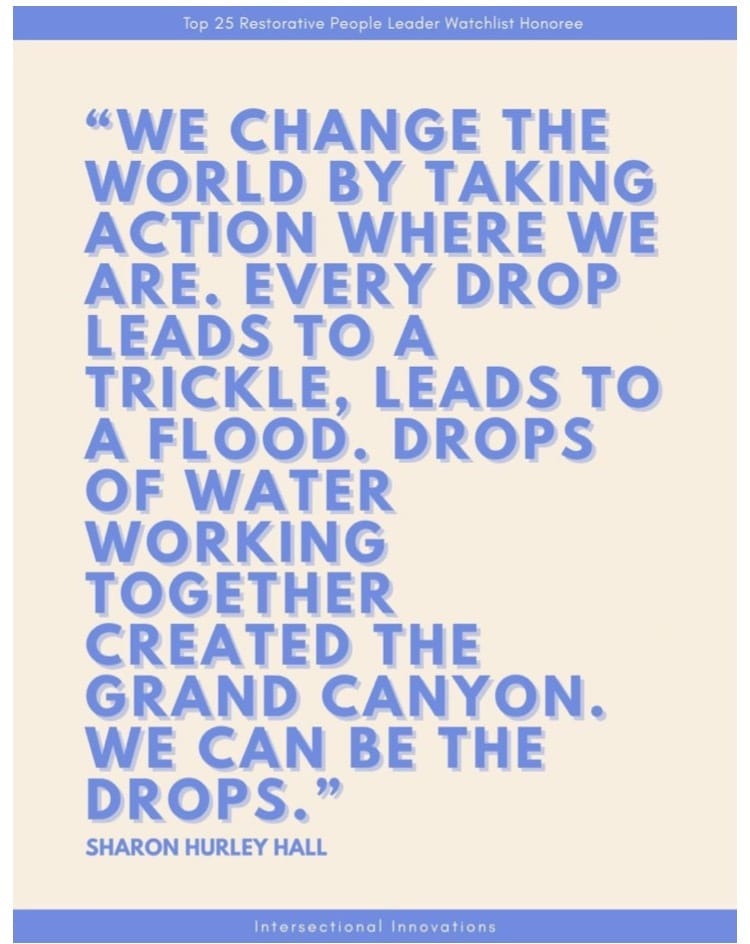
A quote from Sharon Hurley Hall: ‘We change the world by taking action where we are. Every drop leads to a trickle, leads to a flood. Drops of water working together created the Grand Canyon. We can be the drops.”
You see the pattern too, right? I’m being reminded that no choice in service of belonging is too small.
It’s easy to read the news, witness what is happening to friends and neighbors, receive notices about massive increases in premiums from the health insurance company, and end up overwhelmed. It’s easy to feel defeated, assuming that we aren’t strong, powerful, or rich enough to make and difference and foment change.
The forces of scarcity, division, and oppression are strong. The are also phenomenal marketers. Making us believe we are small, weak, and ineffectual is part of the plan.
The above quotes from theleftistlawyer, Clarissa Pinkola Estes, and Sharon Hurley Hall remind us that we already have all that we need, right now, today, to build liberated relationships, communities and systems.
In fact, every choice we make, every word we speak will serve either belonging or othering. Every choice matters. We are more powerful that we believe. If we weren’t, why would systems work so hard to convince us we are not?
What’s a “little” act you can take today in service of belonging? Let me know! Let’s share our ideas and inspire each other.
We can be drops!
Learning Resource
Ezra Klein and Ta-Nehisi Coates re: Charlie Kirk and “where we go from here”
After Charlie Kirk was murdered, New York Times columnist, Ezra Klein wrote that Kirk “was practicing politics the right way.” Coates followed that with an op-ed saying that Klein was “whitewashing” Kirk’s work and legacy. The two then met to talk through their disagreement and perspectives on Klein’s podcast.
There is so much ground covered in this conversation.
I’d invite you to pay attention to how Klein and Coates’ experiences as a white man and Black man, respectively, impact their perspectives, reactions, and decision-making. “White Liberals” are often critiqued for their inability to de-center their own experiences when thinking about larger issues. I see evidence of this showing up repeatedly in Klein’s comments.
Klein’s main goal seems to be to find a middle ground for compromise, to “reach across the aisle.” Coates, meanwhile, is focused on unapologetically centering and protecting every individual’s full humanity. These two ideas do not have to be in opposition. There is, however, a difference between having a difference of opinion and denying someone’s whole-personhood. As James Baldwin said, “We can disagree and still love each other unless your disagreement is rooted in my oppression and denial of my humanity and right to exist.”
I would paraphrase that to say, “we can build coalition across movements and with unlikely partners unless those partners work to oppress and deny the humanity and right to exist of any people or group.”
The second thing to note is that Klein and Coates, though in significant disagreement, choose to come into and stay in dialogue. Their conversation is important. I’m glad they had it in public so that we can bear witness and learn.
The link to the YouTube is above.
If you are an auditory learner, here is the link to the podcast.
If you prefer to read, here is a link to the transcript.
If you want to talk after reading, listening, or watching, you can book a free one-hour discovery call with me to process your thinking. Yes, you’ll learn more about what I do and how I do it, and I promise not to turn it into a “hard sell.” 😉
Taking Care of Our Feet
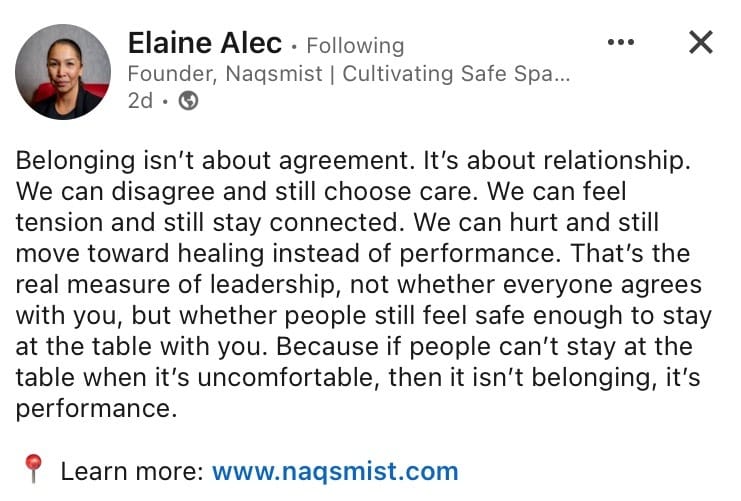
A LinkedIn Post from Elaine Alec reads: “Belonging isn’t about agreement. It’s about relationship. We can disagree and still choose care. We can feel tension and still stay connected. We can hurt and still move toward healing instead of performance. That’s the real measure of leadership, not whether everyone agrees with you, but whether people still feel safe enough to stay at the table with you. Because if people can’t stay at the table when it’s uncomfortable, then it isn’t belonging, it’s performance.”
Building on the conversation between Klein and Coates above, Elaine Alec highlights that belonging requires care and the centering of humanity within disagreement. Once, in a small group we were both in, S. Leigh Thompson, named that navigating tension and conflict well is critical to building community. “What are your pathways for dissent?” he asked us to consider.
As leaders, and as people in relationship with other people, what are our pathways to dissent? We are going to disagree. We are going to cause and receive harm. How can we think ahead of time about our rules of engagement to stay connected and move toward healing as Alec, founder of naqsmist.com calls us to do?
One Last Thing

A monarch butterfly perches on a stalk of goldenrod on a sunny evening.
Butterflies are the ultimate symbols of change, aren’t they? They are born one thing and die something completely different. They are land animals and then they can fly.
It’s not a new idea to look at butterflies as examples of lessons in trusting that the changes we go through in our own lives will have positive outcomes. That evolving from who we are in one phase of ourselves to someone else in the next phase is a natural process, a positive process.
I won’t sugarcoat it. The primordial ooze phase, within the cocoon and dissolving from our old self to reform into the new, absolutely sucks. It hurts. It’s lonely. It’s dark.
And then the light comes.
We’re going to have dark, oozy, painful days. We can expect them. We can be kind to ourselves during them. We can let our friends know we need to share their light for a while.
And we can trust that our butterfly day is coming.
Looking for more resources, recommendations, and tools for your journey? Upgrade to a paid subscription for either $10/month or “Name My One-Time Gift.”
Ready for the next step?
Upgrade to a paid subscription for additional content and the password to a curated webpage of resources - including questions to go deeper
Forward this newsletter to a friend or colleague - it really helps!
Subscribe to get the FREE version of this newsletter every month.
Book a FREE one-hour discovery call to learn how I might partner with you or your organization to embed equity and belonging work into your everyday practices.
Reply